Skill Building with the Cylinder Block Puzzle
Aug 30, 2022
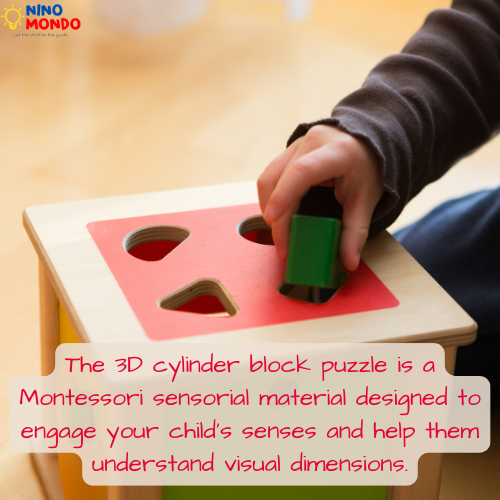
The 3D cylinder block puzzle is a Montessori sensorial material designed to engage the senses of sight and touch and introduce the child to the visual dimensions.
It has cylinders with knobs to hold each cylinder with the pincer grips. The cylinders differ in height and diameter and progress from small to large. Each cylinder fits onto a specific hole on a solid brick of wood.
The child learns to perceive preliminary mathematical concepts such as weight and size and differentiate the cylinders according to size. The child will later be able to apply language to the visual differences such as thick and thin, small, and large, and short and tall.
It prepares the child's hands for later writing. The way the child holds the cylinder knobs prepares them to hold a pencil. Children can start working on the cylinder block from age of 16+ months
The 3D cylinder block puzzle is a Montessori sensorial material designed to engage the senses of sight and touch and introduce the child to visual dimensions. The aim is to build gross motor skills in children early on and develop the necessary muscles to perform everyday functions more efficiently.
It has cylinders with knobs to hold each cylinder with the pincer grips. The cylinders differ in height and diameter and progress from small to large. Each cylinder fits into a specific hole in a solid brick of wood.
The child learns to perceive preliminary mathematical concepts such as weight and size and differentiate the cylinders according to size. They also develop motor coordination and the ability to better apply language to visual differences such as thick and thin, small and large, and short and tall.
It also prepares the child's hands for writing through gross motor skills development. The way the child holds the cylinder knobs prepares them to hold a pencil. Children can start working on the cylinder block from the age of 16+ months
Benefits of the 3D cylinder block puzzle: Gross Motor Skills Development
1. Promotes hand and eye coordination
The cylinder helps the child process the visuals by pairing the cylinders with the appropriate hole in the block that matches the diameter and depth. Thus, it helps to develop hand and eye coordination as crucial fine motor skills development in children.
2. Developing self-control and discipline
The child learns the internal characteristics of the blocks. The goal is for the child to find where the cylinder fits through a visual examination that is more complicated than a mechanical examination. This helps essential skill-building in children through self-control and discipline.
3. Preparation for mathematics
It lays the foundation for mathematics and language as the child learns to use words such as height and diameter. Just like in math, where there’s only one correct answer, the cylinder blocks have the same principle- there’s just only a particular cylinder that will fit into a particular hole.
The blocks help in skill development like patience and acceptance in children as they learn to wait patiently to get the correct answer and be okay with making mistakes until they learn to do it right.
4. Helps the eye to perceive differences in dimension
Through the differences in dimensions of the cylinder blocks, the child learns to engage in different voluntary movements.
They learn to coordinate and use their fingers to grasp the blocks, eventually preparing themselves to learn the coordination of fingers for holding the pencil and writing. The cylinder blocks help the child use their fingers in a pincer grip for holding a pencil.
5. Helps to develop fine motor skills in early childhood
The blocks are heavy, so the child must use maximum effort; thus, it engages gross motor skills.
6. Refinement of voluntary movement
The game facilitates the development of voluntary movement in children as the child learns to fit all the cylinders with a single precise hand movement. It also refines visual-motor coordination since the child must concentrate on doing it correctly.
How to play with the 3D cylinder block puzzle to develop gross motor skills?
The first step is to encourage them to play the game. You can do it in these simple steps:
- Tell your child that you have something to show her.
- Show her the blocks and say, “These are cylinder blocks.”
- Show the child to carry one of the blocks by gripping it with both hands, carrying it at the weight level, and place on the table. Sit together near the table
- Show the child how to take out, starting with the largest cylinder.
- Use your thumb and two fingers to pinch above the knob of the cylinder to the right. This will teach them basic fine motor skills in early childhood. Then, slowly pull the cylinder out if it’s whole and place it in front of the wooden block.
- Take out all the cylinders using the same procedure until all the cylinders are out of the hole. Do it from the largest to the smallest. This will help impart gross motor skills to children.
- Now, tilt the block forward to show your child that all the holes are empty.
The next step is to teach them how to put the cylinders back
- Now, tell her, “I took them out, and now I’m going to show you how to put all of them back.”
- Then, put back all the cylinders into their appropriate hole in random order. Hold the knob of the cylinder the same way you did while removing them, then slide them back in their holes.
The final step is to invite your child to take the cylinder blocks puzzle out and put them back in just as you did.
The child can now work individually with any of the cylinder blocks independently as they have developed the necessary gross motor skills to work independently.
You can present it to your child without instructions and let them immerse themselves in the object-fitting activity. This is an activity that requires minimal to no instructions. Due to the self-correctional nature of the puzzle, the child can figure out the right piece to fit into the puzzle on their own. Notice the pride & joy of achievement when they do!
Why We Recommend This?
We love the Cylinder Block Puzzle because it’s more than just a toy. As children explore each cylinder, they aren’t just learning to match shapes; they are developing problem-solving skills, refining their sense of size and dimension, and building quiet confidence through self-correction.
Each “click” of the right fit brings joy, independence, and a deeper understanding of how things work. It’s one of those beautiful Montessori materials that lets children think with their hands and learn through doing. 💛
FAQs related to the Cylinder Block Puzzle
1: What is the Cylinder Block Puzzle in Montessori?
It’s a wooden block with knobbed cylinders varying in size, designed for children to remove and return based on height and diameter.
2: What age group is it for?
Children around 2½ to 3½ years old typically use it as part of the Sensorial curriculum.
3: What skills does it develop?
It refines visual discrimination, fine motor skills (grasping the knob), coordination, concentration, and introduces dimension language like tall/short or thick/thin.
4: What is “control of error” and how does it apply here?
The puzzle is self-correcting: if a cylinder doesn’t fit, the child sees the error and adjusts, promoting independent learning.
5: Can parents use it at home?
Yes — with guidance, the activity can be introduced at home to encourage independent skill building through repetition and exploration.
Don't miss a beat!
New moves, motivation, and classes delivered to your inbox.
We hate SPAM. We will never sell your information, for any reason.