Skill Building with the Peg Board
May 24, 2023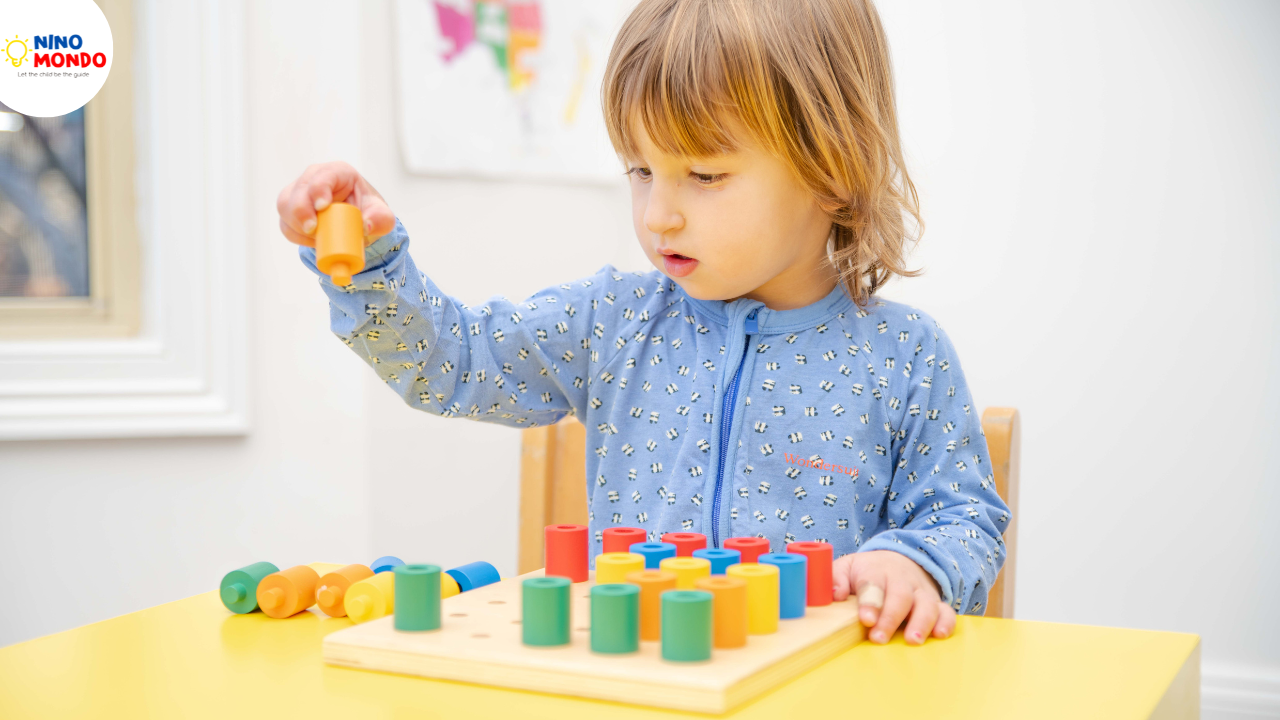
As parents, we always look for ways to help our children develop new skills and learn through play. One classic toy that has been used for generations to help children build essential skills is the peg board.
This simple yet versatile toy offers a range of benefits for children of all ages and abilities.
In this blog, we will explore the benefits of using the peg board for skill building and provide tips on how to incorporate it into your child's learning and play.
What is a Peg Board?
A peg board is an evenly spaced holes and pegs arranged on a board, where the pegs can be inserted into the holes. The board and pegs come in various shapes, sizes, and colors. Some boards are designed for specific ages, while other types of boards can be used by children of all age groups.
Benefits of Using the Peg Board for Skill Building
Develops Fine Motor Skills
The pegboard is an excellent tool for developing fine motor skills in early childhood. It requires using small muscles in the hands and fingers to manipulate the pegs and insert them into the holes. This activity strengthens hand muscles, improves finger dexterity, and enhances hand-eye coordination.
Improves Hand-Eye Coordination
Using a peg board requires children to coordinate their hand movements with their visual perception. They need to align the peg with the hole and insert it accurately. This process helps develop hand-eye coordination, essential for many other activities, such as writing, drawing, and sports.
Enhances Cognitive Abilities
The peg board is also an excellent tool for enhancing cognitive abilities in children. It promotes problem-solving, critical thinking, and spatial awareness. Children must figure out how to fit the pegs into the holes and plan their movements accordingly. This type of activity helps develop cognitive abilities and prepares children for more complex tasks in the future.
Improves Counting and Math Skills
Pegboards can also help children develop their counting and math skills. Parents can use the pegs to create patterns to help children learn to count by ones, twos, or threes. Parents can also use the wooden pegs to teach basic addition, subtraction, less than, and more than.
Enhances Creativity and Imagination
Pegboards offer children the opportunity to be creative and use their imaginations to create their own designs and patterns. You can encourage your child to experiment with different color combinations and patterns and use their creativity to create new and exciting designs.
Develops Problem-Solving and Critical Thinking
Playing with a peg board can also help children develop problem-solving and critical-thinking skills. By working to fit the pegs into the holes or stacking them on top of each other, children are learning to solve puzzles, anticipate outcomes and overcome obstacles. This type of problem-solving is an important skill that will serve children well throughout their lives.
Develops Social Skills
Playing with a peg board can also help children develop critical social skills like sharing and taking turns. Parents can encourage their children to work together to create designs and patterns or to take turns adding pegs to the board. This type of cooperative play helps children learn to communicate and work together, a crucial skill for success in school and life. You can also play the game of “exchanging my wooden pegs with yours,” which is another interesting way to develop social skills.
Here are a few tips to keep in mind when using a peg board for skill building:
- Start with the Basics. If your child is new to using the board, start with basic activities that involve simply placing the wooden pegs into the holes on the board.
- Some children like to start by first removing the pegs one by one before they can get to the phase of putting them in the holes or stacking them.
- Once they have mastered the basics of a peg board, you can move on to more complex STEM activities of counting, adding, subtracting, less than, or more than.
- Provide guidance and support as needed to help your baby master the skill. For example, you can use hand-over-hand assistance to guide their movements, point to show where to put a wooden peg, or provide verbal prompts to help them stay focused.
- Keep the activity fun and engaging by incorporating games, challenges, or rewards for completing tasks.
In conclusion, the peg board is a versatile and valuable tool for children's learning and development. From fine motor skills development and color recognition to math skills and critical thinking, the game offers a wide range of benefits for children of all ages and abilities.
By incorporating various activities, you can customise the peg board to meet your baby's needs with varying levels of ability. So why not give it a try!
Why We Recommend This?
Imagine your child picking up a little peg, deciding where it fits, and then placing it carefully—one small action at a time. With the peg board, each moment is a chance to practice precision, build focus, and feel proud of “I did it myself.”
As the pegs stack and patterns form, your child is silently strengthening fine motor skills, learning cause and effect, and building early math thinking—while simply playing. It’s a gentle blend of joy and learning that invites curiosity, independence, and quiet achievement. 💛
And for more such tips and insights, click here.
FAQs
1: What is a peg board?
A board with evenly spaced holes and pegs, used for placing, stacking or creating patterns.
2: What skills does a peg board develop?
It builds fine motor skills, hand-eye coordination, and spatial awareness, problem-solving and early math.
3: What age group benefits most from this?
Toddlers and pre-schoolers mainly, but children of various ages can use the board in increasingly complex ways.
4: Do I need special tools or instructions?
No — simple setups, pegs and a board suffice; you can add complexity gradually.
5: How do I support the activity at home?
Start simple, show how once, and then let the child explore; build in fun challenges like patterns or counting.
Don't miss a beat!
New moves, motivation, and classes delivered to your inbox.
We hate SPAM. We will never sell your information, for any reason.