The Power of Cause and Effect for Development in Childhood
May 01, 2022
Cause and effect, the principle that one action can lead to another, plays a vital role in early childhood development. From the moment they are born, children begin to navigate the world and make connections between their actions and the outcomes they experience.
In this article, we will explore the significance of understanding cause and effect during development in childhood, both academically and spiritually.
We will also discuss how the Montessori approach and gentle parenting techniques can create a safe environment for children to understand their actions and consequences.
Join us on this exploration as we uncover the remarkable influence of cause and effect on child development.
1. Understanding Cause and Effect
At its core, cause and effect is the understanding that actions have consequences. When children recognise this as a chain, they start to comprehend the world around them and their place within it. This cognitive process helps shape their development in various ways.
2. Importance of Early cognitive skills
As per child development philosophies, embracing the concept of cause and effect nurtures essential skills such as critical thinking, problem-solving, and logical reasoning, all of which align with the principles of Montessori theory.
By encouraging children to explore actions and their effects, they can establish meaningful connections, predict outcomes, and gain a profound comprehension of the world around them.
3. Emotional and Social Development
Understanding the stages of cognitive and emotional development in childhood is crucial for creating effective educational strategies.
Through the Montessori approach in early childhood, children who understand the concept of cause and effect, take responsibility for their actions, and recognise the impact they have on others. This fosters empathy, compassion, and cooperation, enhancing their emotional intelligence and social interactions.
4. Spiritual Growth
The understanding of actions and their consequences extends beyond the physical realm and aligns with spiritual principles. Recognising the consequences of their actions empowers children to develop a sense of responsibility, accountability, and mindfulness.
5. The Influence of Newton's Reaction
Sir Isaac Newton's third law of motion, "For every action, there is an equal and opposite reaction," provides a profound analogy for cause and effect. Incorporating this concept into gentle parenting practices can lead to a deeper understanding and ignite children's curiosity, promoting their healthy development in childhood.
6. The Montessori Approach and Cause and Effect
The Montessori theory aligns harmoniously with the idea of cause and effect. The Montessori approach encourages hands-on, experiential learning, where children actively engage with their environment. Through Montessori activities, children can perform actions when they engage with Montessori materials, observe natural consequences, and develop their cognitive and problem-solving abilities.
Since Montessori materials and toys are passive, they emphasise simple learning of actions and their effects. Unlike battery-operated toys, Montessori toys are passive and won't move until a child picks them up and plays with them.
7. Gentle Parenting and Cause and Effect
Gentle parenting emphasises respectful, empathetic, and nurturing Montessori approaches to parenting.
By incorporating cause and effect into gentle parenting techniques, parents can guide their children to comprehend the consequences of their actions in a supportive and compassionate manner. This fosters emotional growth, self-discipline, and decision-making skills and boosts healthy development in childhood.
E.g., if your child refuses to wear a coat before stepping out on a winter day, instead of reprimanding them, if you let them experience the chill a bit and let them arrive at the conclusion that they need a coat before they step out next time, is a good way to learn about actions, their effects, and their natural consequences too. Be mindful of not pointing it out to them by saying "I told you so".
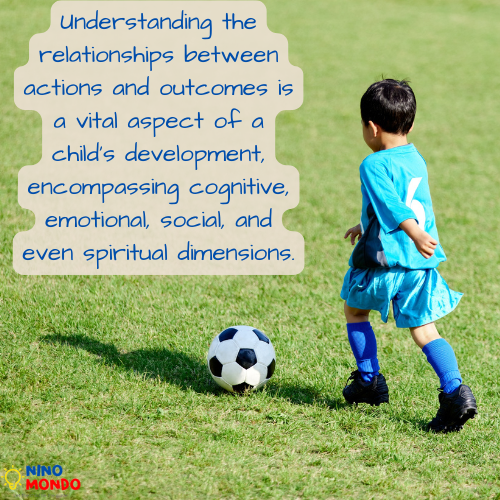
Understanding the relationships between actions and outcomes is a vital aspect of a child's development, encompassing cognitive, emotional, social, and even spiritual dimensions. It empowers children to navigate the world with greater awareness and responsibility.
The Montessori approach and gentle parenting techniques offer effective tools for teaching children to grasp these relationships.
Why We Recommend This?
We recommend cause-and-effect activities because they turn everyday play into powerful learning moments. When a child drops a ball and watches it roll, presses a button and hears a sound, or opens a latch to find what’s inside, they are not just playing, but also discovering how the world works.
These simple actions build curiosity, focus, and problem-solving skills while nurturing patience and persistence. Check our mindful Montessori courses to learn about more such activities and resources to support your child’s growth. 💛
Don't miss a beat!
New moves, motivation, and classes delivered to your inbox.
We hate SPAM. We will never sell your information, for any reason.